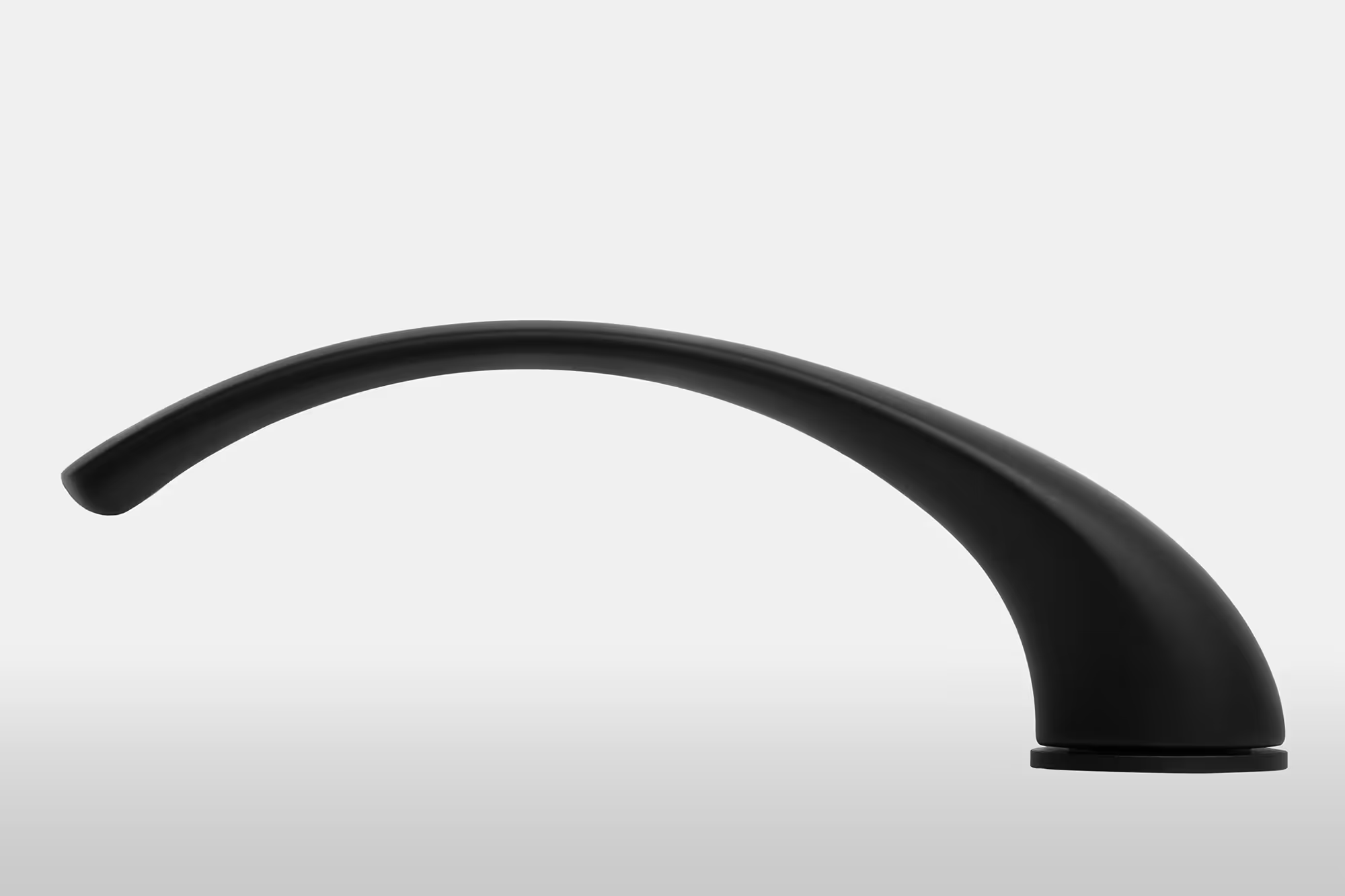
Is a handle just a small detail? Only at first glance. In reality, it’s one of the objects we touch most often and think about least—until something goes wrong: a loose grip, excessive strain, a cramped wrist, a slippery surface, or a mechanism that loses its precision after just a few months.
For FIMET, designing a handle doesn’t mean starting with the form, but with the gesture. And designing affordably doesn’t mean cutting corners, but achieving a synthesis in which every choice—whether formal, technical, or production-related—contributes to making that experience natural, reliable, and accessible over time.
In this sense, a good handle is one you can figure out at first touch.
- The first criterion is comfort.
The hand must immediately know where to rest and must feel welcomed, not constrained. The best designs avoid unnecessary sharp edges, feature rounded or slightly recessed sections, and guide the hand’s natural movement rather than resisting it. Even when the design language is rigorous or minimalist, the grip must never be compromised: it is the point at which the design is truly validated. - The second criterion is the effort required.
A well-designed lever is often more inclusive than a Door knob it does not require a firm grip or a sharp twist of the wrist: it can be operated with the palm, the fist, and even the forearm. For FIMET, this principle is not just about ergonomics but perceived quality: a handle that operates effortlessly is a handle that delivers value every day. - The third criterion is legibility.
A good handle should make its function self-evident. Its shape, orientation, and grip area should make interaction intuitive. Here lies a subtle yet fundamental distinction: minimalism must never lead to ambiguity. Even the most basic designs must maintain absolute clarity of use, while more expressive ones can guide the user’s actions naturally, without the need for explanation. - The fourth criterion concerns feel, materials, and finishes.
The quality of a handle is felt in the hand even before it is seen. Satin-finished or slightly textured surfaces offer control and stability, while materials such as stainless steel, brass, or bronze tell different stories of strength, presence, and durability. At FIMET, the choice of material is never purely aesthetic: it is always a response to a specific context of use. The harmony between form, material, and function is what transforms a technical object into a credible one. - The fifth criterion is inclusion.
A door handle isn’t designed for an “ideal” hand, but for real people: those with small and large hands, young and old, strong and frail users. Human-centered design means broadening our perspective and treating these differences as an integral part of the design, not as exceptions. If a door handle works well even in the most complex situations, it will work better for everyone. - The sixth criterion is verification.
At FIMET design process doesn’t stop at the drawing board: it involves prototypes, real-world testing, and direct observation. Just a few targeted tests are enough to determine whether the motion feels natural, whether the grip is intuitive, and whether any issues arise over time. This rapid, hands-on approach allows for early corrections, preventing the design from becoming locked into solutions that are only theoretically sound.
It is precisely on this set of criteria that the meaning of “affordable” is based, according to FIMET. Not as a compromise between quality and cost, but as a design discipline.
Affordable means focusing design expertise where it really matters: on the grip, stability, precision of the mechanism, quality of the finishes, and durability. It means maintaining control over production to ensure consistency, repeatability, and reliability. It means collaborating with designers based on a clear principle: every detail, every choice, and every complexity must serve a real purpose in the user experience.
For this reason, in its collaboration with designers, FIMET simply seek new forms, but solutions that successfully integrate form, function, and production. A design is evaluated not only for what it expresses, but also for how it performs: how it feels in the hand, how it is used, how it stands the test of time, and how it fits into a cohesive product family.
In this sense, a FIMET handle FIMET “affordable” simply because it costs less. It’s affordable because it delivers a high, tangible, and perceptible level of quality within a smart manufacturing system.
And when that happens, the result is simple: a device that works well today and will continue to do so tomorrow, without you ever having to give it a second thought.